Designing an Archive in the Digital Environment: The YKY Case
September 8, 2026
A New Approach to Digital Archiving: A Standardized, Sustainable, Institution-Owned System
Today, the secure, organized, and accessible preservation of an institution’s information and records is no longer merely an archival activity; it has become a strategic necessity for preserving and sustaining institutional memory.
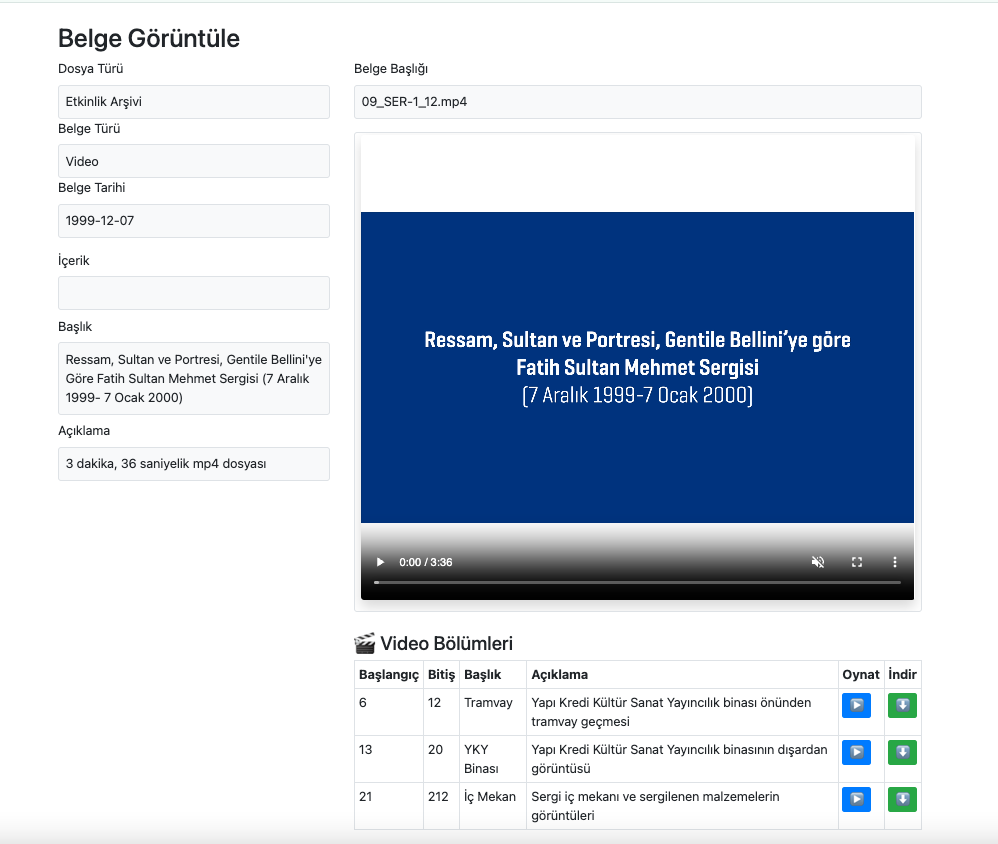
Developed in response to this need, the YKY Archive Application has been implemented as a system that brings together the fundamental principles of archival science and modern software technologies.
A System Developed with Open-Source Technologies
As the Yapı Kredi Research Library, we developed the YKY Archive Application using our own resources. The application was developed with Django, the web framework of the Python programming language. By choosing open-source technologies, our institution has been able to build an archival system tailored to its needs without incurring any licensing costs.
MySQL is used as the database management system, while Apache 2.4 has been selected for deployment and operation. Thus, from software development to the server environment, there has been no need for proprietary or paid solutions that would increase licensing costs.
This approach provides more than just a cost advantage. The use of open-source technologies also offers significant flexibility, allowing the system to be developed in accordance with the institution’s needs, maintained over time, and expanded with new functionalities when necessary.
What Matters as Much as Technology: The Archival Approach
The success of an archival software system depends not only on the programming language in which it is written or the database it uses. One of the most important factors is establishing the correct archival logic behind the software. Particular emphasis has been placed on developing the scenario and technical infrastructure required to manage, from a single central system, both modern archival records generated through the institution’s daily business and operational activities, and the institutional memory content produced through its publishing activities, as well as the special archival collections held within the library. Physical materials such as paper documents, CDs, DVDs, plaques, and other diverse media are digitized and transferred into the system in formats including still and moving images.
This approach has been adopted as a fundamental principle in the development of the Archive Application, and the software architecture has been designed in accordance with the requirements of archival science. At the core of the system is a unit > file > document hierarchy. This structure establishes a relationship between the institution’s organizational structure and its archival records. In other words, the units within the institution, the types of files produced by these units, and the documents contained within those files are treated as an interconnected whole.
As a result, a document is no longer merely an independent file uploaded to the system; it gains meaning through its place within and relationship to the institutional production process.
The Foundation of a Digital Archive Is the Physical Archive
An important point that is often overlooked in digital archiving projects is that software alone cannot correct an archival structure that has not been properly designed.
For the hierarchical structure used in the YKY Archive Application to function effectively, the physical archive must also be organized according to the same principles.
It is essential to correctly determine which files a unit produces, how these files are classified, and under which files the relevant documents should be maintained. This forms the foundation of the structure to be transferred into the digital system.
Therefore, a digital archiving project is not merely a software development initiative; it is also an institutional transformation project that provides an opportunity to review the organization’s existing processes for document creation, classification, preservation, and access.
An Information System Owned by the Institution, Not Individuals
One of the project’s most important objectives is to eliminate information and document systems that have gradually become dependent on individuals within the institution.
Storing information on individuals’ computers, in personal folders, or through methods known only to particular employees can create significant risks for an institution. In cases of changes in responsibilities, employee departures, or situations in which the person possessing the relevant knowledge cannot be reached, access to part of the institution’s collective memory may become difficult.
With the Archive Application, the aim is to move information and documents away from individual ownership and dependency and place them within an institutional system. In this way, information ceases to be a resource possessed or managed by a particular individual and becomes part of the institution’s shared and sustainable memory.
Access to Information from a Single Point
Another fundamental objective of the system is to bring information and documents dispersed across different environments together within a common structure as much as possible.
Through a centralized archival structure, the aim is to reduce users’ dependence on different individuals, computers, or physical archive spaces when they need to access information.
This approach also brings standardization. Classifying documents within a defined hierarchy and incorporating them into the system according to common rules contributes to the development of an institution-wide archival culture.
Conclusion: More Than Technology
It would not be accurate to evaluate the YKY Archive Application merely as a software system used within the institution. This initiative is a transformation project that brings together the cost advantages offered by open-source technologies, the organizational discipline provided by archival science, and the need to preserve institutional memory under a single framework.
While open-source technologies such as Django, MySQL, and Apache 2.4 form the technical foundation of the application, the unit > file > document approach constitutes its archival foundation.
The ultimate objective, however, goes beyond technology: to create an institutional memory by freeing the organization’s information and documents from dependence on individuals, to facilitate access to information, and to establish a sustainable and standardized archival structure.
Because a good digital archive is not merely a system that stores documents; it is a living institutional memory that preserves an organization’s past, serves its present, and carries knowledge into its future.