A few months ago, while showing examples from our collection to a group visiting our library and archive, I came across that wonderful GÖK-TUR aircraft poster. As I began to trace the story behind the poster and research the company, a remarkably intriguing story emerged. This is, after all, the most rewarding part of our work: getting lost in the material and uncovering its story. That is precisely why I wanted to write about the short yet extraordinary history of GÖK-TUR.
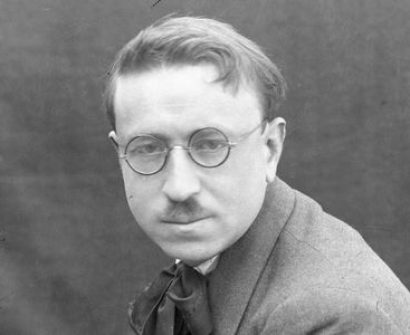
At the center of this story is pilot Mehmet Altunbay, the founder of GÖK-TUR. His background more than explains why the airline he established was such a bold undertaking. Graduating from the Military Aviation School in Soviet Russia in 1933, Altunbay received three commendations thanks to his talent. However, in 1939, due to intense repression against Turks under the regime and a death sentence issued against him, he and his friends made the daring decision to escape by aircraft. Although their plane was heavily damaged during the escape, they managed to make a forced landing in Iran. When the Soviets invaded Iran and they were about to be extradited, they sought refuge at the Turkish Embassy and were saved. These events were later depicted in the 1967 film Cell No. 501.
After approximately nine months of this tense ordeal, Altunbay and his companions moved to Baghdad. With the help of the embassy, they attempted to return to their homeland by train, only to be captured by the British. After spending two and a half months in prison and narrowly escaping execution thanks to the intervention of Turkey’s Ambassador in Baghdad, they finally set foot on their longed-for homeland in 1941.
Altunbay’s first stop in Turkey was alongside another giant of Turkish aviation history, Nuri Demirağ. While serving as chief pilot at Demirağ’s Gök [Sky] Schools, he also conducted test flights of the domestically produced Nu.D.38 aircraft, further honing his mastery of the skies. After Demirağ’s aircraft factory closed, Altunbay turned to the Air Force in 1943. By 1945, he embarked on a long and stable career with Turkish Airlines that would continue until 1960.
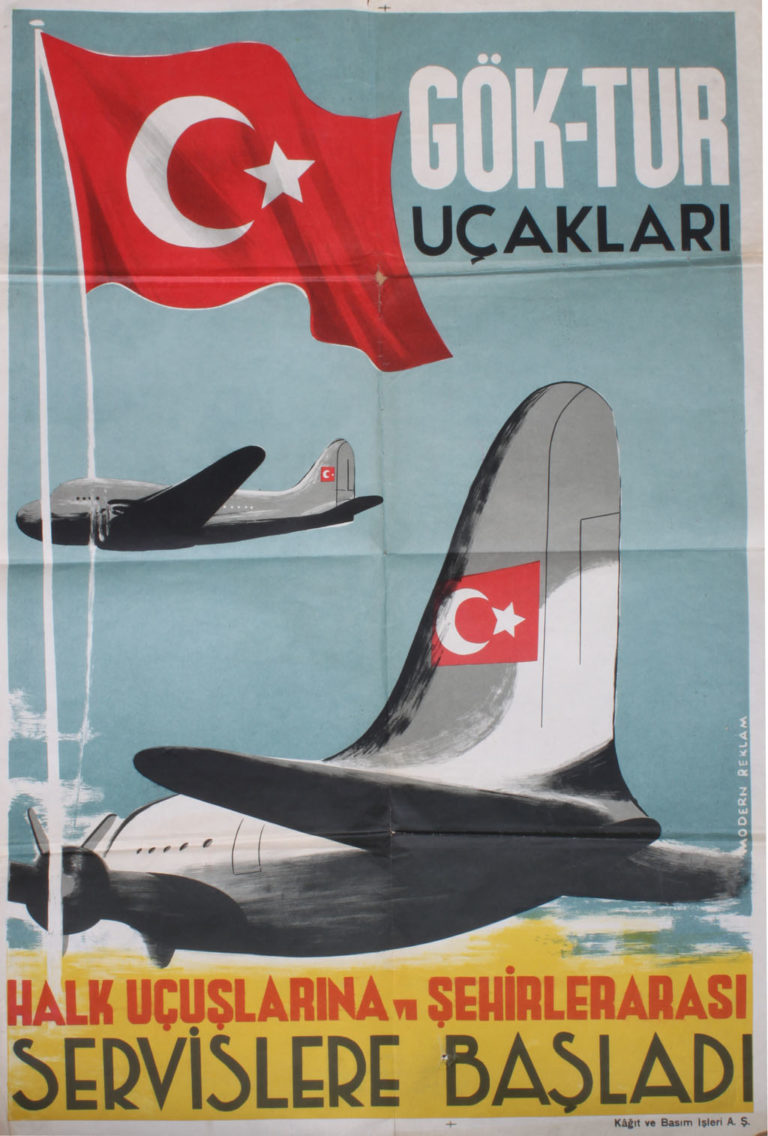
GÖK-TUR was born in 1952 as a “dream project” during the most mature phase of Altunbay’s intensive professional career. Amid his years at Turkish Airlines, he sought to crown all his accumulated experience in aviation with wings of his own. In August 1952, with great courage, he established one of Turkey’s first private civil aviation companies. The colorful poster in our collection announcing “Public Flights Have Begun” represents the ultimate legacy of a pilot who had been trained under Nuri Demirağ, hardened in the Air Force, and risen to prominence at Turkish Airlines.
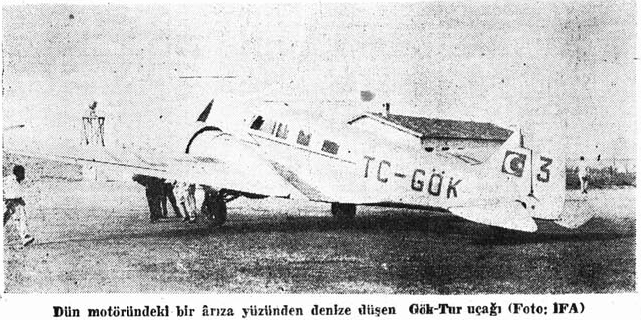
In 1952, with all this experience, Mehmet Altunbay founded GÖK-TUR with just two aircrafts, marking Turkey’s first private civil air transport initiative. Initially, the twin-engine, six-passenger Airspeed Consul—registered as TC-GÖK—entered service, as seen on the poster in our collection. It was accompanied by a single-engine, four-passenger Percival Proctor V, registered as TC-GÜN.
Although the poster proclaimed “Public flights have begun,” the economic conditions of the time and the public’s hesitation toward aviation pushed Altunbay toward a creative solution: newspaper transportation. GÖK-TUR began flying to deliver Istanbul’s fresh news to Anatolia. However, this promising venture would be shaken early on by a tragic incident.
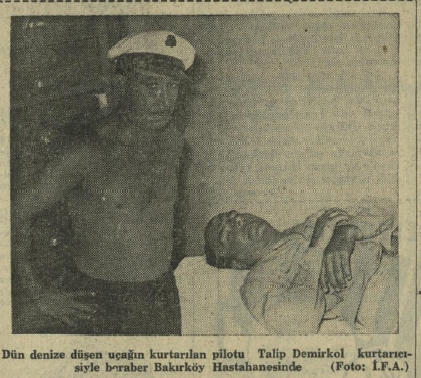
According to newspaper reports from the time, on September 26, 1952, at around 11:30 AM, pilot Talip Demirkol took off from Yeşilköy with 600 newspapers aboard the TC-GÖK aircraft, bound for İzmir. Shortly after takeoff, one of the aircraft’s engines exploded with a loud noise (some sources attribute this to excessive weight). Demirkol immediately attempted to return to Yeşilköy, but when the second engine also failed, he was forced to make an emergency landing in the Marmara Sea.
What makes this accident even more remarkable is that it was first noticed by an artillery training aircraft flying in the area. The Italian ship Lando, whose position was relayed via radio, rushed to assist. Tragically, pilot Talip Demirkol did not even know how to swim. Managing to escape by breaking the aircraft’s windows, he had swallowed a large amount of seawater and was seriously injured. He was rescued at the last moment by a small boat from the Lando and, after being brought ashore, was taken to Bakırköy Psychiatric Hospital.

By a strange twist of fate, another military aircraft crashed in Eskişehir on the same day, and its pilot—like Demirkol—also survived. That day, Turkey was talking about two miracles.
Having lost its most important aircraft just three months after beginning operations, GÖK-TUR was unable to bear the financial and emotional burden of the accident. In early 1953, this first private civil aviation venture in Turkey ceased its operations and disappeared from the stage of history. Mehmet Altunbay continued his duties at Turkish Airlines until 1960, while no significant information could be found about Talip Demirkol. Altunbay passed away in 1987, and his notes and memoirs were compiled by his family and published in 1989 under the title The Turk Who Flew to Freedom: The Memoirs of Mehmet Altunbay.
Today, when I look at that GÖK-TUR poster preserved in our archive, I see not just a colorful piece of paper, but the determination of a pilot who escaped from the Soviet Union, the desperate struggle for survival in the waters of the Marmara Sea, and the brief yet courageous adventure of our civil aviation history. Instead of a dry catalog entry, I wanted to tell this story—because sometimes, a single poster can hold within it the dreams of an entire era.
Furkan Sevim
Istanbul Research Institute Library Supervisor